

Page last updated: September 16, 2026
Page reviewed by: Dr. Cara O’Neill, FAAP
For web accessibility options: Click/tap the floating blue icon on the right.
Clinical Trial Summary
Study: “A Phase 1/2, Multicenter, Open-Label Study to Evaluate the Safety, Tolerability, Pharmacokinetics, and Pharmacodynamics of DNL126 in Pediatric Participants With Mucopolysaccharidosis Type IIIA (Sanfilippo Syndrome Type A)” ClinicalTrials.gov ID NCT06181136
Trial Listing: Read this clinical trial’s information on ClinicalTrials.gov, for more details including contact information to reach out to the study sites, full inclusion and exclusion criteria. We encourage you to check the Clinicaltrials.gov link frequently for updates on possible new study sites and changes in enrollment status or criteria.
Study opened: December 2023
Study design: Multicenter, open-label
Study status: Active, not recruiting
Route of administration: Intravenous through a central venous port
Study Length: The core study period is 25 weeks (approximately 6 months) and is followed by a 72-week (approximately 18 month) open-label extension (OLE).
Brief summary of DNL-126
DNL-126 is an investigational enzyme replacement therapy for patients with Sanfilippo syndrome type A. The enzyme deficient in Sanfilippo type A, SGSH, has been engineered to cross the blood brain barrier by binding to the transferrin receptor on blood vessels. It is intended to treat disease pathology in the brain and body.
This is the first study trialing the use of DNL-126 in humans.
Updates, press releases, web articles, presentations regarding DNL-126
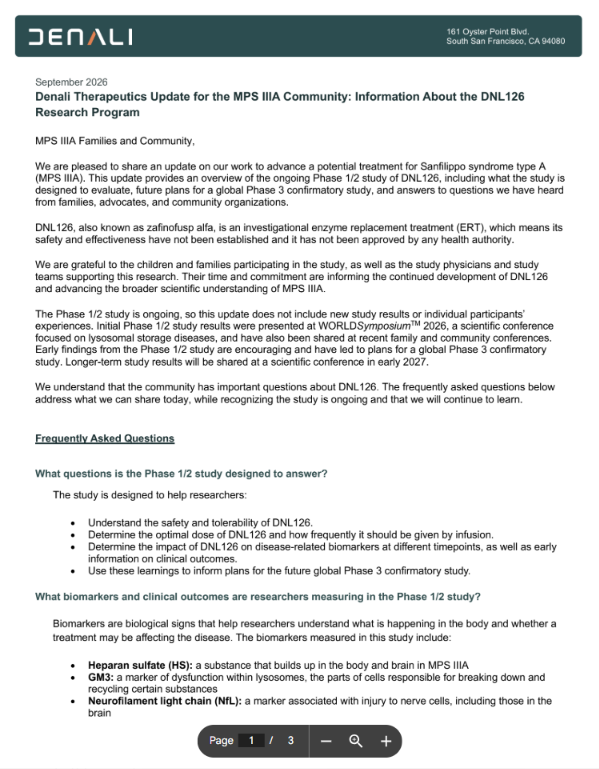
September 2026
Denali Therapeutics shared an update on its Sanfilippo Type A enzyme replacement therapy, DNL 126. Read the update.
February 2026
At the 2026 WORLDSymposium, Denali Therapeutics announced data from its DNL126 (ETV:SGSH) program for Sanfilippo syndrome type A (MPS IIIA), as well as Hunter syndrome (MPS II), highlighting the potential of its Enzyme TransportVehicle (ETV) to enable the delivery of enzyme replacement therapies (ERT) to the whole body, including the brain. According to Denali, preliminary Phase 1/2 study data show treatment with DNL126 substantially reduced disease biomarkers in cerebrospinal fluid (CSF) and peripheral tissues, including an 80% mean reduction in CSF heparan sulfate, in Sanfilippo syndrome type A (MPS IIIA); safety profile generally consistent with established enzyme replacement therapies. Read Denali’s press release.
September 2025
As of September 17, 2025, Cohort A3 of the DNL-126 study has finished enrolling participants, which means all three study cohorts (A1, A2, and A3) are now fully enrolled.
Per Denali, “In order to move the study forward as quickly as possible, we have closed enrollment for the optional study groups (Cohorts B1 and B2, older sibling of B1). With these updates, the study is now fully enrolled. Our focus going forward will be on completing this study and continuing to advance our MPS IIIA program forward in order to deliver this potential treatment to the Sanfilippo syndrome Type A community.”
May 2025
We are pleased to share that Denali Therapeutics has opened additional enrollment spots in its clinical trial of DNL-126 for Sanfilippo Type A (MPS IIIA). Cohort A3 enrollment will be expanded to an additional 6 participants.
For more information, read the statement below from Denali …
– – – – – – – – – – – – – – – – – –
We are pleased to share with you that the update to our Phase 1/2 clinical study in Sanfilippo syndrome Type A (MPS IIIA) has now been reflected on ClinicalTrials.gov. We have amended the study plan to expand Cohort A3, increasing the enrollment size by 6 participants to a total of up to 26.
Current enrolling cohorts in the Phase 1/2 study are below. Details on the inclusion and exclusion criteria can be found on ClinicalTrials.gov.
Cohort A3:
Eligible participants with a confirmed diagnosis of MPS IIIA. Cohort A3 will now enroll up to an additional 6 participants, for a total of approximately 10 participants. Due to high interest in the study, physician investigators and study teams are reviewing eligible participants from the existing waitlist, and many of the available slots have already been allocated across the four active sites.
Ongoing Cohorts without change to enrollment numbers:
Cohort B1 — Eligible participants less than 28 months old (2 years and 4 months) who have a severe phenotype, as determined by the Physician Investigator at the study site. Cohort B1 will enroll up to four participants.
Optional Cohort B2 — Enrolling eligible older siblings of participants in Cohort B1. Before a Cohort B2 participant may be screened, their younger sibling must be confirmed to be eligible for dosing in Cohort B1. Cohort B2 will enroll up to 4 participants.
Note: B1 participants may be enrolled even if they do not have an older sibling and/or their older sibling does not wish to participate.
April 2025
In a “community update” to the MPS community shared with patient advocacy organizations on April 2, Denali stated, “Sanfilippo syndrome Type A Program Update: We continue progress on our investigational therapy for Sanfilippo syndrome (MPS IIIA). Through the FDA’s START program—an initiative designed to accelerate development of treatments for rare diseases—we’re working closely with the agency to align on an approval path.”
November 2024
Denali stated in a public third-quarter report on its website, “Preliminary data from our Phase 1/2 study of DNL126 in MPS IIIA demonstrate a robust reduction from baseline in CSF heparan sulfate levels, including normalization. Based on these data and a positive regulatory environment, we recently expanded the study to support a potential accelerated path, said Ryan Watts, Ph.D., Chief Executive Officer of Denali Therapeutics.” Read more.
October 2024
Denali announced addition of optional Cohorts B1 and B2 to the DNL126 study and that the cohorts are open and actively recruiting participants. “Criteria for Cohorts B1 and B2 are outlined below, and the Physician Investigators (PIs) will assess interested and eligible participants, and will review any eligible participants from the existing waiting list. The PIs across the four active sites continue to collaborate on the review process of interested participants,” said Denali in an email to the Foundation.
Optional Cohort B1: This cohort is now recruiting and will begin enrolling eligible participants less than 28 months old (2 years and 4 months) who have a severe phenotype, as determined by the Physician Investigator at the study site. Cohort B1 will enroll up to four participants.
Optional Cohort B2: This cohort is now recruiting older siblings of participants in Cohort B1 and will begin enrolling eligible participants who are greater than or equal to 28 months (2 years and 4 months) to less than 18 years old and who are. Before a Cohort B2 participant may be screened, their younger sibling must be confirmed to be eligible for dosing in Cohort B1. Cohort B2 will enroll up to four participants.
December 2023
The University of California-San Francisco (UCSF) is announced as a clinical trial site for DNL-126 for Sanfilippo Type A in the U.S. Read more. Additionally, UNC Children’s Research Institute is announced as another site. Read more.
August 2023
In August 2023, Jonathan Gall and Kim Ramsey of Denali Therapeutics presented to the community during Cure Sanfilippo Foundation’s ADVANCE 2023 conference. They updated participants on Denali’s mission, preclinical work on DNL-126 and plans for the upcoming enzyme replacement clinical trial for Sanfilippo type A. Their presentation can be viewed below.
January 2023
- In the above press release, Denali stated that it expects to have “biomarker proof of concept and safety data from the Phase 1/2 study by the end of 2024.” Additionally, it expects to present preclinical data at WORLDSymposium 2024 in February 2024 and initiate dosing in Phase 1/2 in early 2024.